Thursday, February 18, 2010

Choose one character from The Grapes of Wrath and list four important quotes said by or written by this character. Explain what you believe these quotes reveal about the character

Tom Joad

"What the hell you want to lead 'em someplace for? Jus' Lead 'em."
I loved this quote for several reasons outside of the book's meaning of it. This reveals to me that Tom is very opinionated and free spirited, and doesn't like it when people tell him what to do with his life. That doesn't mean he doesn't appreciate advice or guidance, he just doesn't want to be forced to take a single path. He is just living.

" I don't give a damn who know it. An' I'm goin' to my old man's place so I don't have to lie to get a job."
This shows me he is honest and he isn't easily affected by other people's view of him.

"But sometimes, a guy'll be a good guy even if some rich bastard makes him carry a sticker."
This tells me his family and him aren't very wealthy and that he is a straightforward guy. He doesn't hide much.

"I ain't got a thing in the worl' to win, no matter how it comes out."
He has nothing. He is a loner and sort of a rebel.


Thursday, February 4, 2010

Interview

For someone two weeks overdue on her first baby, Leslie Gereghty was surprisingly optimistic about doing an interview over the phone. Her voice is unique; a raspy calm whisper similar to someone with a constant cough or frequent asthma. She takes deep breaths in between words, I admire that. People don’t think before thinking anymore. As I edit our interview, I am having a hard time deleting the pauses and long breaths I had marked. They seem well placed-intentional. She sounds tired though, more than usual. Coming from an afternoon meeting, she had been rushing around all day. From day one, I had always looked at Leslie with great amazement. She seems like one of the people that are too creative. She is one of the people that you model your life after, an artist in every meaning of the word. I dressed formally when we met for the first time, sweater vest and slacks. She told me before I left, “Never wear a tie.” I respected that. I have noticed that she is always running. She always has something going on. At first I wondered if being so wrapped up in music all day, had taken away any of the joy it once gave her. “Yeah, it has, unfortunately. I think in one hand it’s good, because now we play music all day long, but it does mean that I don’t play music during the day, and then come home and play music just to relax me anymore.”

Interview: Leslie Gereghty

Q: How and when we’re you first inspired to pursue music as a career?

I think I probably knew from a very young age that I do would do music. I don’t ever remember not being a musician; I started music lessons when I was four.

Q: After going through college and getting your bachelors in music, what would you advise someone my age to do right now if they wanted to pursue the same thing?

Choose your colleges and majors carefully. There are just so many careers in music between law and business and performing. There are so many. So explore, really research different alternative degree programs that are applicable to the things you want to learn.

Q: After getting your bachelors, then masters at northwestern, you pursued doctoral studies in the Department of Music and Human Learning at the University of Texas at Austin. What did you do? What was it like?

Music and human learning- college level music teaching and education. It was a lot of research; and I already had a masters and bachelors degree in piano performance, so it was something new. I was always working as a musician. I never just went to college. I was always teaching. So that was good, because some people don’t even work in college, and they are dumb (Laughs). So I was gaining experience while I was learning. I ended up leaving Texas for a good job offer that I couldn’t resist.

Q: What was your job offer?

Senior editor at a music publishing company.

Q: How did these courses change your views of music? What did it teach you that you didn’t already know? Did it change your views on music?

That’s a good question. It was a lot about how people learn and how…I’m not sure if this will translate, but a lot of teachers teach things, and the students don’t really learn. Teachers have to be responsible for their students learning. It taught me a lot about how the human brain works and learns and processes information, which helped me.

Q: Do you feel you made the right decision going into an art related field, opposed to a more guaranteed higher paying business profession?

Yeah, there is a saying that you don’t choose music, music chooses you (Winton Marsalis), and I think that is very true. I think that there are three different groups of people. People that do music because there is nothing else, and they are often in trouble. Then, there is the second group that do it because they can’t see themselves doing anything else. Then the third group of people that find a balance to do music and something else, which is cool, but I was definitely the second group. I don’t want to make it seem like if you are unsure about something not to do it, but you will definitely know. It’s all about your experience.

Q: Even with a bachelor’s degree in music, did you feel unqualified going into music as a profession? Were you nervous? Did you ever feel that you weren’t good enough?

Oh yeah. Of course I did. It takes a lot of time to gain enough confidence and experience to feel good about your self as a musician. There are still parts of my business that I feel like a total klutz. Even though I never doubted my degree choice, there were so many times I wanted to quit. I had serious struggles with doubts.

Q: How did you overcome those? Did you put those thoughts aside?

I realized I was there for me. Regardless of if I won the competition or if my career was important to anyone else, I didn’t care what they thought. I knew what I was doing and I knew why I was there. It wasn’t their life. I didn’t care. You just have to focus on what you want. It’s like that band teacher you had. He said you weren’t good enough. You weren’t good at the skills he required, but he didn’t see what you WERE good at. That’s why you have to keep going, and not always listen to people that may be professionals.

Q: With a baby on the way, and your business directed towards music lessons for kids and adults, do you think that having the baby will give you a chance to learn about a child and their views on music as they grow?

Oh sure. It will be really fun to expose her to music at such a young age. And that will probably be a whole new area of curiosity for me.

Q: How did opening a music studio teach you about business, the balance of money and time, and how to keep a business open in troubling times?

Well, it teaches you everyday. And I mean every day; and I come across something I don’t understand everyday. But, I also have sought out professionals that can support my areas of little knowledge and help me understand more; people like accountants and mentors and business advisors. I have no business background and they helped a lot.

Q: Has your business been affected by the market? How so?

I do think so, because any time before, that I’ve ever started a teaching studio, it just exploded. But it has been a lot slower of process this time. People will call and ask how much it is, and say thank you very much and hang up. Music is not a necessity. Like for you when you never got lessons, it is probably because it just didn’t fit into what you needed at the time. It was last on the list. It is unfortunate.

Q: How does your work affect their personal life? Do you still find yourself doing all the things you once did before this company was your main priority? (Jamming)

Yeah, it has, unfortunately. I think in one hand it’s good, because now we play music all day long, but it does mean that I don’t play music during the day, and then come home and play music just to relax me anymore. So yeah, it has in a way.

Q: Is music still fun for you? Or has it become business?

Well, my job is fun, you know? I absolutely love what I do, so its fun in that way, but its still a job so I have to do things I don’t like to. Like, memorize the chords to a song by an artist I hate, because a kid wants to learn it. (Laughs)

Q: Did teaching music affect you in any way? What have you gained from teaching?

I just love the look on people’s faces when they get something. And it has brought so much happiness into my life that I just want to share it. And I want other people to feel that. It became a matter of fulfillment for other people, where as performing its all about you, and who you are impressing. I just feel a lot better sharing it.

Q: Were you ever an intern? Where? How was your experience? If not, why?

Actually I never was. Well, when I first started teaching I got a job at a college level, and I was assigned to a professor that mentored me because I didn’t have any college teaching experience. And I had to watch his lessons and he had to watch mine and it was annoying and I hated it. But I learned a lot from it.


Revision Questions:

What can I add to the intro?

Do you have any suggestions for the sub headline?

Do you think the intro matches the interview?

Friday, January 29, 2010

Internship: Week 3: Last Day


This photo displays the design aspect of my internship project. I did a lot of advertising for them, needed or not (haha).

I liked this one most because it is calm but also flashy. I think it displays a theme of modernism here, flaunting helvetica bold with various color gradients and mixed opacities. I like it.


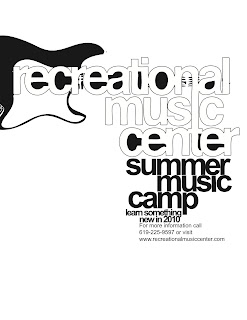
This one is a summer camp sheet I was asked to design. I originally made this on illustrator, saved it as a jpeg, inserted it into illustrator again, and ran a live trace on it, giving it the hand drawn wavy look on the text. I once again feel like this displays an aspect of modernism. With illustrator, your possibilities are endless.

Wednesday, January 27, 2010

Internship Final Week- Day 3
Leslie Gereghty- Recreational Music Center (Owner/Teacher)

1) Q: After getting your bachelors, then masters at northwestern, you pursued doctoral studies in the Department of Music and Human Learning at the University of Texas at Austin. What did you do? What was it like?

Music and human learning- college level music teaching and education. Lots of research; and I already had a masters and bachelors degree in piano performance...so it was something new. I was always working as a musician. I never just went to college. I was always teaching. So that was good because some people don’t even work in college…and they are dumb (Laughs). So I was gaining experience while I was learning. I ended up leaving Texas for a good job offer that...you know I couldn’t resist.


Q: What was your job offer?

Senior editor at a publishing company..Music publishing.


2) Q: Do you feel you made the right decision going into an art related field, opposed to a more guaranteed higher paying business profession?

Yeah, there is a saying that (Winton Marsalis) you don’t choose music, music chooses you. And I think that is very true. And I think that there are three different groups of people. People that do music because there is nothing else...and they are often in trouble. Then, there is the second group that do it because they can’t see themselves doing anything else. Then the third group of people that find a balance to do music and something else…which is cool…but I was definitely the second group. I don’t want to make it seem like if you are unsure about something not to do it, but you will definitely know. It’s all about your experience.


3) Q: Even with a bachelor’s degree in music, did you feel unqualified going into music as a profession? Were you nervous? Did you ever feel that you weren’t good enough?

Oh yeah. Of course I did. It takes a lot of time to gain enough confidence and experience to feel good about yourself as a musician. And there are still parts of my business that I feel like a total klutz. Even though I never doubted my degree choice, there were so many times I wanted to quit. I had serious struggles with doubts.


Q: How did you overcome those? Did you put those thoughts aside?

I realized I was there for me. Regardless of if I won the competition or if my career was important to anyone else…I didn’t care what they thought. I knew what I was doing and I knew why I was there. It wasn’t their life. I didn’t care. You just have to focus on what YOU want. It’s like that band teacher you had. He said you weren’t good enough. You weren’t good at the skills he required, but he didn’t see what you WERE good at. That’s why you have to keep going, and not always listen to people that may be professionals.


4) Q: How does your work affect their personal life? Do you still find yourself doing all the things you once did before this company was your main priority? (Jamming)

Yeah, it has. Unfortunately. And I think in one hand its good, because now we play music all day long; but it does mean that I don’t play music anymore, and then come home and play music just to relax me anymore. So yeah, it has in a way.


5) Q: Did teaching music affect you in any way? What have you gained from teaching?

I just love the look on people’s faces when they get something. And it has brought so much happiness into my life that I just want to share it. And I want other people to feel that. It became a matter of fulfillment for other people…where as performing its all about you, and who you are impressing. I just feel a lot better sharing it.


Monday, January 25, 2010

Internship Final Week- Day 1
In the course of one typical workday, how many different people do you directly work with? How many people are indirectly affected by your work.
On a typical day, I will work with anywhere from 2-5 people. The studio is usually quiet due to the lessons in progress, but different teachers will rotate in, and I will help them prepare for a lesson, break down, manage their upcoming schedule etc. I don't think people are indirectly affected by my work. I can't think of how anyone would be.

Describe your direct collaboration with others—how does it go & how does it influence the work?
Direct collaboration is something I haven't experienced in great amounts at my internship. I have been a very independent worker in everything I have been doing. I have been helping a lot with events that the RMC has been having such as their Fun Friday and RMC Jam events. I guess that could count as collaboration, because the teachers and I work together to accomplish a common goal. Working together with the teachers to host good events, teach productive lessons and ensure a common sense of learning together have been a couple main goals I have tried to accomplish with the teachers and students at the RMC. I think this has influenced the work in a very positive way. I hope someone has walked away with something more than a music lesson because of something I have done.

Describe your indirect impact on others through your work—there are probably many people you never actually see who are affected by your work. How does this happen? How does this influence your work?
I think by designing advertisements for the RMC, people have seen them and have began to think about taking music lessons. Who knows if I have inspired the next Hendrix, Peart, or Lambert. This influences my work by inspiring me to keep designing for companies, because all it takes is the right design to catch someones eye, enough for them to read the poster and be inspired.

How might different resources change the way we work?
I think with better resources, my internship could expand their lessons and appeal to an older and more experienced audience. Right now, their classes are more directed towards the young (3-13) and older (40-70). I think by having more resources (Better drums, acoustic drums, brass lessons etc) they could close the gap between 13 and 40 and appeal to young adults such as myself.

How would you use collaboration if you were in charge?
If I were in charge, we would work a lot more as a tightly knitted team. A team bound to teach every kid a musical instrument before they get an xbox or ps3. To teach them how to think on the spot and play collaborate with friends on more creative things than xbox live. Participate in a quartet, join marching band. Something has to change with the exposure of music to kids.

Friday, January 22, 2010

Internship:Week 2, Day 4
My week was a very difficult week. I was still trying to figure out what I wanted to do as my final project. I ran into conflict with my mentor several times about what they wanted me to do and what I wanted to do myself. There were arguments and disagreements, but through talking with my mentor and teachers, I have realized that I can only do the best I can do. I guess the highlight is negative, but positive in the way that it was a learning experience. Life at work is constantly busy, stressful and confusing. People often encounter obstacles and challenges. Some hit the obstacles and fall, while others find a way around them. I am trying to learn how to find my way around them. My week was a roller coaster. I hope I can get off of it soon.


Internship: Week 2, Day 3
Today I hit a brick wall. I was stuck, sick and extremely curious about how this internship and my projects were going to get finished on time. It lead me to think about how someone in my situation would take this obstacle, and overcome it. How someone in the world would climb over the brick wall and keep going. It has made me wonder about how incredibly hard it must be to have constant pressure and stress to keep your business afloat and a constant income in these times. I am just an intern, and I am feeling so much stress just to succeed. From now on, I am more inspired to constantly try to find a better way not to have to encounter these walls; and to find a way around them before I hit them.

Questions For My Mentor:

Do you feel you made the right decision going into an art related field, opposed to a more guaranteed higher paying business profession

How do you feel this choice affected your life and future?

With a baby on the way, and your business directed towards music lessons for kids and adults, do you think that having the baby will give you a chance to learn about a child and their views on music as they grow?

Even with a bachelors in music, did you feel unqualified going into music as a profession?

How did opening a music studio teach you about business, the balance of money and time, and how to keep a business open in troubling times?